
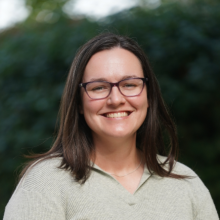
Lauren Dial, Ph.D. (she/her), is an Assistant Professor of Psychology at California State University, Fresno, where she teaches undergraduate courses and graduate seminars in developmental psychology. She also serves as Graduate Coordinator for the M.A. in General/Experimental Psychology program. Her research broadly examines how social and cultural contexts shape development, health, and well-being across childhood, adolescence, and emerging adulthood. Much of her work has focused on food cognition, food insecurity, identity, and health-related decision making among children, families, and college students. Dr. Dial is deeply committed to mentorship and has worked closely with numerous undergraduate and graduate students on conference presentations, thesis projects, and research projects.
Why did you decide to choose developmental science as a course of study or career?
A: I was first drawn to developmental science during my junior year of college when I had the opportunity to intern, and later work, at a local family resource center. Part of my role involved conducting developmental screenings with young children and families, and it was one of the first experiences that showed me how meaningful developmental research and early intervention can be. At the same time, the experience left me with even more questions about how development unfolds and how broader social, cultural, and environmental contexts influence children and families over time. That experience ultimately introduced me to developmental science and inspired me to pursue it as a career. What has kept me in developmental science is the field's interdisciplinary breadth and expansiveness. Developmental scientists are not confined to one area of psychology. We study cognition, relationships, identity, health, culture, and physical development because development is inherently complex and interconnected. I continue to be fascinated by how these different aspects of development interact across the lifespan and across diverse contexts.
What are you most proud of in your career?
A: I am most proud of the opportunity to mentor students and help create supportive spaces for them to grow as scholars and as people. Many of the students I work with are first-generation college students or come from backgrounds that have historically been underrepresented in academia. As the only openly queer faculty member in my department and someone still relatively early in my career, I am especially aware of how important visibility, representation, and support can be for students navigating higher education. It is truly an honor to witness students recognize their own potential and capabilities over time. Seeing that growth and confidence develop brings a deep sense of fulfillment to my work. While publications and professional accomplishments are important, some of the most rewarding moments in my career have come from mentoring relationships and supporting students as they navigate challenges, discover their interests, and build futures they may not have initially imagined for themselves.
What advice would you give to a student beginning their Ph.D. studies in developmental science or related?
A: Give yourself permission to not have everything figured out immediately. Many students begin graduate school feeling pressure to already know exactly what they want to study or who they want to become as scholars, but developing your research identity takes time. Honestly, by the end of my PhD, I felt like I knew less than when I started because graduate training teaches you just how much there is still to learn. That feeling can be uncomfortable, but it is also a sign that you are growing, asking deeper questions, and thinking more critically about your work. I would also encourage students to fully embrace the process of learning, experimenting, and making mistakes. Graduate school is one of the few spaces where you are expected to try new things, refine your thinking, and grow over time. Equally important is building friendships and community. Graduate school can feel isolating, and having supportive peers and mentors makes an enormous difference. Some of the most meaningful parts of graduate school come not only from research and professional development, but also from the people who support you through it.
Outside of developmental science, what hobbies or activities do you engage in or enjoy?
A: Outside of academia, I am proudly a nerd in just about every sense of the word. I love playing video games and have always seen gaming as one of my favorite ways to relax, connect with friends, and decompress after long days. I'll play about anything if it sounds fun. However, I always come back to team-based shooter games. As a support main, I have learned to embrace the chaos of getting dove in the backline. I also love reading all kinds of books, watching Marvel films, and anything space-related. I thoroughly enjoyed the live stream coverage of NASA’s most recent mission to the Moon. More recently, coloring and junk journaling have made their way into my hobby repertoire. I have always been drawn to stories, worlds, and activities that encourage imagination with a little bit of science, which feels pretty aligned with why I enjoy developmental science. Finally, I also play in a queer kickball league (go Queerios!). I think maintaining hobbies and friendships outside of academia helps create balance, perspective, and most importantly, joy.