
Horowitz Early Career Scholar Program
The Horowitz Early Career Scholar Program takes its name from the year when the adult population of the United States is estimated to become a diverse majority. SRCD is excited to support the professional development of a diverse group of researchers as we move towards this new period. We are seeking applications from both scholars and mentors!
The deadline to submit an application for SRCD's 2026 Horowitz Early Career Scholars Program is on April 17, 2026.
| Quick Links | |
History of the Program
The Frances Degen Horowitz Millennium Scholars Program (MSP) was developed in 1999 as a vehicle to encourage and support scholars from under-represented ethnic/racial groups from North America in pursuing graduate work in developmental science. In 2020, the Wallace Foundation provided funding to SRCD to strengthen the program, extending it from mentorship specifically at the SRCD Biennial to a year-long program. The new name for the extended program is now the Horowitz Early Career Scholar Program. With this extension, the program aimed to more broadly serve scholars who are underrepresented in developmental science, across multiple dimensions of representation within the field.
In 2026, the Spencer Foundation provided additional funding to help sustain the program for another year, reinforcing its continued commitment to supporting early career scholars interested in educational research and quantitative methods, while increasing access to high-quality mentorship and professional development opportunities.
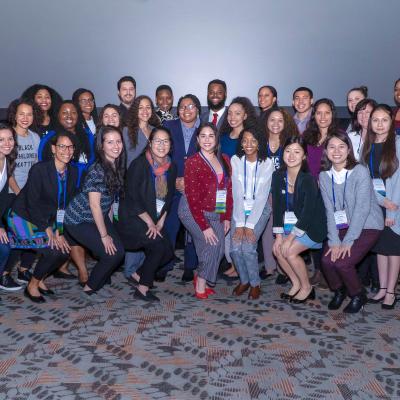
Image to the right features Millennium Scholars Program mentors and mentees at the 2019 SRCD Biennial Meeting in Baltimore, Maryland, USA (March 2019).
Purpose of the Program
The program provides educational and professional development for scholars who are underrepresented in the developmental science field, giving them a launching point for a career in the field of child development, while also granting invaluable opportunities for mentors. More advanced scholars in the field provide graduate students guidance and support in their pursuit of educational and professional goals. The program particularly seeks to support scholars whose work advances educational research and utilizes quantitative methodologies to address developmental focused questions. Individuals from diverse racial, ethnic, and disciplinary groups are recruited to serve as mentors.
Through participation in the Horowitz Early Career Scholar Program, scholars , as well as mentors, have the opportunity to be reimbursed for registration costs for the SRCD Biennial meeting and one pre-conference, as well as participate in a year-long program consisting of monthly seminars and one-on-one mentorship meetings. These experiences enable scholars to gain valuable exposure to the field and allow them to interact not only with their mentors, but also with other scholars and professionals. Mentors have the opportunity to share their lived experience and expertise with students, build their professional networks, and form collaborative relationships that extend way beyond the mentoring period. Mentors and scholars are paired up by the Advisory Committee prior to the start of the program.
Meet the 2026 Advisory Committee
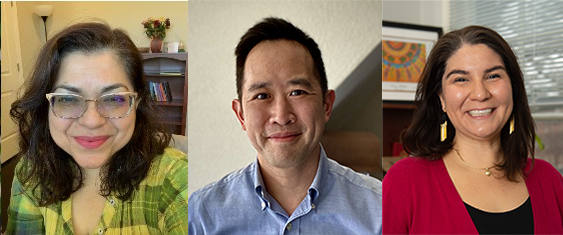
The 2025 Advisory Committee for Horowitz Early Career Scholar Program consists of Dr. Mayra Bámaca (University of California, Merced), Dr. Stephen Chen (Wellesley College), and Dr. Stephanie Miller (The University of Mississippi).
Virtual Orientation
A full-day virtual Horowitz Program Orientation take place on June 29 – June 30, designed to foster meaningful connections and build a stronger cohort community at the start of the program. The day is designed to focus on cohort community building, professional development, and preparing scholars and mentors for program expectations. The orientation will also involve sharing a virtual meal together (gift cards will be provided for lunch). Following orientation, the program will continue with monthly professional development seminars over Zoom, along with one-on-one meetings between scholars and mentors throughout the program year.
Please note that participation in the full-day virtual orientation is required for all accepted scholars and mentors, and cameras must remain on to support active engagement and community building.
What To Expect
When: June 29 - June 30, 2026
This will include the following benefits for all scholars and mentors:
- Cohort community building
- Professional development sessions
- Networking
- Opportunities to briefly present research
- A "virtual lunch" (gift cards will be provided)
- Panel with Policy Fellows or other researchers
“[The program was] a natural space to gain resources, build connections and be myself—this is so rare in academia/overall society!”
“In reflection of my academic year, it was truly my favorite part. I hold so much gratitude and hope we can all reconnect again.”
“I am leaving feeling like my professional network has expanded and feeling less alone with respect to being one of the only BIPOC people in my department. Hearing how my experiences are similar to other people in other departments has been comforting.”
Mentor reflections:
“It is rewarding and important to connect with budding scholars. I felt that I was well paired and that I was really helping to make a difference by providing additional support and guidance in the trajectory of a scholar.”
“I like providing an opportunity to students to have a supportive and safe space to talk about issues and questions they may have in their training…[it is] beneficial to hear various opinions regarding different topics that trainees may not get from their immediate supervisors.”
“I loved getting to meet [my mentee] and am thrilled to continue to support her through her dissertation development journey and additional shared workstreams after the program ends!”
Benefits
| All applicants (scholars and mentors) |
|
| Scholars |
|
| Mentors |
|
Commitments
| All applicants (scholars and mentors) |
|
| Scholars |
|
| Mentors |
|
Eligibility Requirements
| All applicants (scholars and mentors) |
|
| Scholars |
|
| Mentors |
|
Scholar Application Materials
- Curriculum vitae or resume
- A brief bio (200 word limit)
- Academic transcript (unofficial transcripts are accepted)
- Description of research project (current or planned; may involve dissertation research but this is not required) and other professional development goals that would be the focus of the scholar’s Individual Professional Development Plan (750-word limit)
- Responses to the following questions (maximum 300 words each):
- Please summarize your career goals, current academic and research interests, and any experiences relevant to the Towards 2044: Horowitz Early Career Scholar Program
- Why would participating in the Towards 2044: Horowitz Early Career Scholar Program be important for your career development?
- In your view, what are key obstacles faced by scholars from under-represented groups who are pursuing careers in developmental science? What are the unique perspectives and strengths available to such scholars? How can programs like this one help to address the obstacles and build on the strengths?
Apply here
The deadline to apply has passed.
Mentor Application Materials
- Curriculum vitae or resume
- A brief bio (200 word limit)
- Responses to the following questions:
- Please summarize your career goals, current academic and research interests, and any experiences relevant to the Towards 2044: Horowitz Early Career Scholar Program and your commitment to mentoring scholars from under-represented groups.
- In your view, how can a program like the Towards 2044: Horowitz Early Career Scholar Program best support scholars from under-represented groups pursuing careers in developmental science?
Apply here
The deadline to apply has passed.
Scholar Application Mentor Application
Please log in using your SRCD credentials.
The deadline to submit an application for SRCD's 2026 Horowitz Early Career Scholars Program is on April 17, 2026.
For inquiries, please contact scholar@srcd.org.
How We Are Funded
This program would not be possible without the generous funding of the Wallace Foundation and Spencer Foundation.